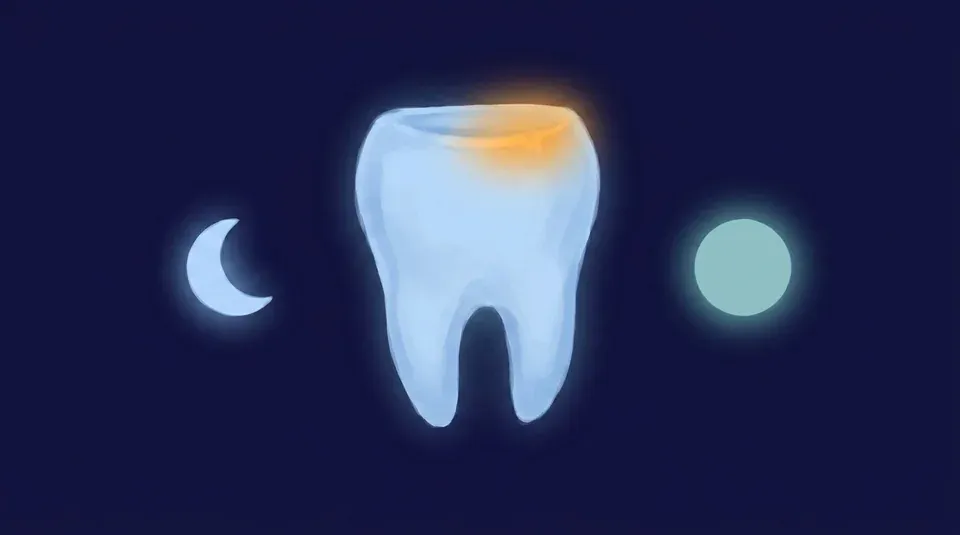
Bruxism is the name for what a jaw does when it clenches, grinds or braces with nothing to chew. It is not a disease and it is not something you have. It is something you do — awake, asleep, or both — usually without knowing.
This is the plain version: what it is, how common it is, how to tell whether you do it, what it can lead to, and what actually helps. If you already know which half is yours, Sleep Bruxism vs Awake Bruxism goes deeper on the split.
What bruxism is
The international definition is repetitive jaw-muscle activity: clenching or grinding the teeth, or bracing or thrusting the jaw (Lobbezoo et al., 2013). Chewing, talking and swallowing are what the jaw muscles are for. Bruxism is the same muscles working when there is no job to do.
It comes in two forms that share a name and not much else.
- Sleep bruxism happens while you are asleep. It is not a decision and it is not a habit in the everyday sense; it is generated by parts of the nervous system you have no conscious access to (Lavigne et al., 2008).
- Awake bruxism happens while you are up. Mostly it is clenching or holding the teeth together during concentration, stress or effort — at a desk, in traffic, in the gym.
One thing worth getting straight early: grinding is the noisy, famous form, and it is the minority. Most night-time activity is silent clenching. Nobody hears it, including you.
How common it is
More common than most people assume, and more common still when someone measures instead of asks.
A 2024 meta-analysis pooling studies from around the world put sleep bruxism at roughly one adult in five when people are asked, and awake bruxism at roughly one in four (Zieliński et al., 2024). In the subset of studies that measured people in a sleep lab rather than asking them, the sleep figure came out well above the self-reported one. Both forms are most common in younger adults and fall off with age.
Those are averages across very different studies, so take them as a rough size, not a precise rate. The direction is the useful part: if you clench or grind, you are in a large group, and a good share of that group does not know they are in it.
How to tell if you do it
There is no single sign. These are the ones that usually send people looking:
- Sore or tired jaw muscles in the morning. The muscles that close the jaw have been working overnight.
- Headaches at the temples on waking, where one of those muscles sits.
- A dentist pointing at wear, flattened edges, chipped enamel, or small cracks. This is the sign that tends to arrive years after the behaviour started.
- Someone hearing it. Only grinding makes a sound, so silence proves nothing.
- Catching yourself at it. Teeth together, jaw set, while reading or working. Once you start looking for it during the day, most people find it quickly.
- Bite marks or ridges along the inside of the cheek or the edge of the tongue.
All of these tell you it might be happening. None of them tells you how much, how often, or which form. The morning-after feeling is a surprisingly poor guide to the night: two nights in a row can differ a lot, and what you remember on waking is not a record of what happened. For the daytime half, noticing is available — you are there. For the night half, the only honest answer to "what does my jaw do?" is to measure it while you sleep, over more than one night.
Is it bad for you?
Not as a rule, and it helps to be precise about this, because the internet is not.
Bruxism is jaw-muscle activity. For a lot of people it never produces anything worth noticing. What it can produce, in some people, over time, is a set of consequences that are worth taking seriously:
- Tooth wear. The clearest and most measurable one. Teeth are hard, but they are not designed to be ground against each other for hours a night, for years.
- Sore jaw muscles and tension headaches. Muscles that work all night are tired in the morning, the same as any others.
- Jaw-joint trouble. Temporomandibular disorders (TMD) are a real disorder with a label of their own. Bruxism is one of several things that can contribute to them in people who are susceptible; it is not the cause and it is not destiny.
- Broken dental work. Fillings, crowns and veneers take the same force the teeth do.
The useful question is not "is bruxism bad" but "is mine producing consequences?" Occasional clenching in a stressful week is something almost everyone does. A jaw that works most nights, or clenches most of the day, is the pattern that tends to leave marks. That is the signal to look at the load and the habit rather than wait.
One more thing, because it comes up: some night-time grinding appears to follow brief moments of lighter sleep that everyone has and nobody remembers (Kato et al., 2001). If you also snore heavily or someone has seen you stop breathing in your sleep, that is a question for a doctor, and a separate one from anything on this page.
What causes it
There is no single cause, and the old idea that it comes from teeth not fitting together has not held up well. What the research points to is different for the two halves.
At night, grinding and clenching cluster around micro-arousals: brief shifts toward lighter sleep, a few seconds long, that happen many times a night in everyone. A study that recorded people in a sleep lab found a consistent sequence — heart rate rises, the brain becomes briefly more active, the jaw muscles switch on, and then the teeth grind (Kato et al., 2001). The activity rides on a normal feature of sleep. That is why willing it away does not work, and why "relax before bed" is a request rather than a technique.
By day, clenching is closer to a habit. It shows up with concentration, effort, stress and strong emotion, and it tends to run on its own once it has become the jaw's default. Most people who do it have no idea until something makes them look.
Things that seem to turn the dial up, for either half, include stress, caffeine and alcohol, smoking, some medications, and disrupted sleep (Lavigne et al., 2008). None of these is the cause. They are the circumstances in which a jaw that is inclined to clench, clenches more.
What helps
This is where the day/night split earns its keep, because the same answer rarely fits both.
By day
The daytime half happens while you are there, so it can be noticed and changed.
- Lips together, teeth apart. That is the resting position of a jaw that is not working. Most people who clench find their teeth are touching more or less constantly. Learning to notice that, and let the jaw hang, is the first step.
- Check-ins. A prompt several times a day — a timer, a sticker on the monitor, an app — that asks "where is your jaw right now?" Over a few weeks, the checking starts to happen on its own.
- Jaw and neck release work. Gentle stretches and self-massage for muscles that have been working overtime. They ease the soreness; they do not stop the clenching by themselves.
- Working on what drives it. If the clench arrives with stress, the stress is worth working on too. It helps. On its own it rarely ends the habit, because the habit outlives the stress that started it.
At night
The night half happens below conscious reach, so noticing is not available. The options are protecting the teeth, and cueing the jaw while you sleep.
- A guard or splint from your dentist protects the teeth from each other. It is well established for that job. What it does not do is change the behaviour: a 2022 systematic review of sleep-bruxism management found the evidence that splints reduce the activity itself weak and mixed (Minakuchi et al., 2022). A guard changes what your teeth survive, not what your jaw does. If your teeth are wearing, that is still worth having.
- Biofeedback takes the other route: a sensor picks up the jaw muscle going to work, and a small cue — a buzz, a sound — prompts it to let go, without the goal of waking you. A 2018 meta-analysis of trials pooling several small studies found that bruxism episodes dropped against placebo devices over five nights, without disturbing sleep, and rated that evidence low to moderate because the samples were small (Jokubauskas & Baltrušaitytė, 2018). What those trials did not do is follow people after the cue stopped, so whether the jaw keeps a new default is still an open question. Biofeedback Training for Your Jaw sets out what it is and what it asks of you.
- Botox in the jaw muscles is something a clinician can offer. It weakens the closing muscles for a few months, which lowers the force. Whether it is right for you is a conversation with them, and Is Masseter Botox Working? covers how you would tell.
- Sleep and evening habits. Later caffeine, alcohol before bed and poor sleep all push in the wrong direction. Fixing them will not switch bruxism off, but it removes fuel.
Who can help
- Your dentist is the usual first stop. They can see wear you cannot, fit a guard if your teeth need protecting, and refer you on.
- Your GP if there is snoring, disturbed sleep, or anything that looks like a breathing problem at night.
- A physiotherapist who works with jaws and necks, for the muscle side: soreness, restricted opening, tension that runs into the neck and shoulders.
- A psychologist or counsellor if stress is clearly the driver and you want help with that rather than with the jaw directly.
- A specialist — an oral-medicine or TMD clinic — if there is joint pain, locking or clicking that does not settle. That is a referral, usually via the dentist.
None of them can tell you what your jaw did last night from an examination. They can tell you what it has done over years, from the wear. That is a different piece of information, and for the night half it is the only one that has been available outside a sleep lab until recently.
Where to start
Work out which half is yours. If you catch yourself clenching by day, start there — it is the half you can change with attention, and you can begin today. If mornings are the problem, or a dentist has shown you wear you cannot explain, the night half is in play, and the first useful move is to find out what your jaw actually does while you sleep, over a couple of nights, before spending money on the answer to a question nobody has measured.
This article is general information, not clinical guidance. It does not describe the diagnosis or treatment of any condition; anything clinical is for your dentist or doctor.
Want to start on the daytime half today? The JawSense app has the check-ins and release work, and it is free to start. Want to know what your jaw does at night? The Jaw Activity Assessment measures two nights in your own bed.