For dentists, physiotherapists & sleep clinicians
JawSense measures what the jaw does at night. Then helps change it.
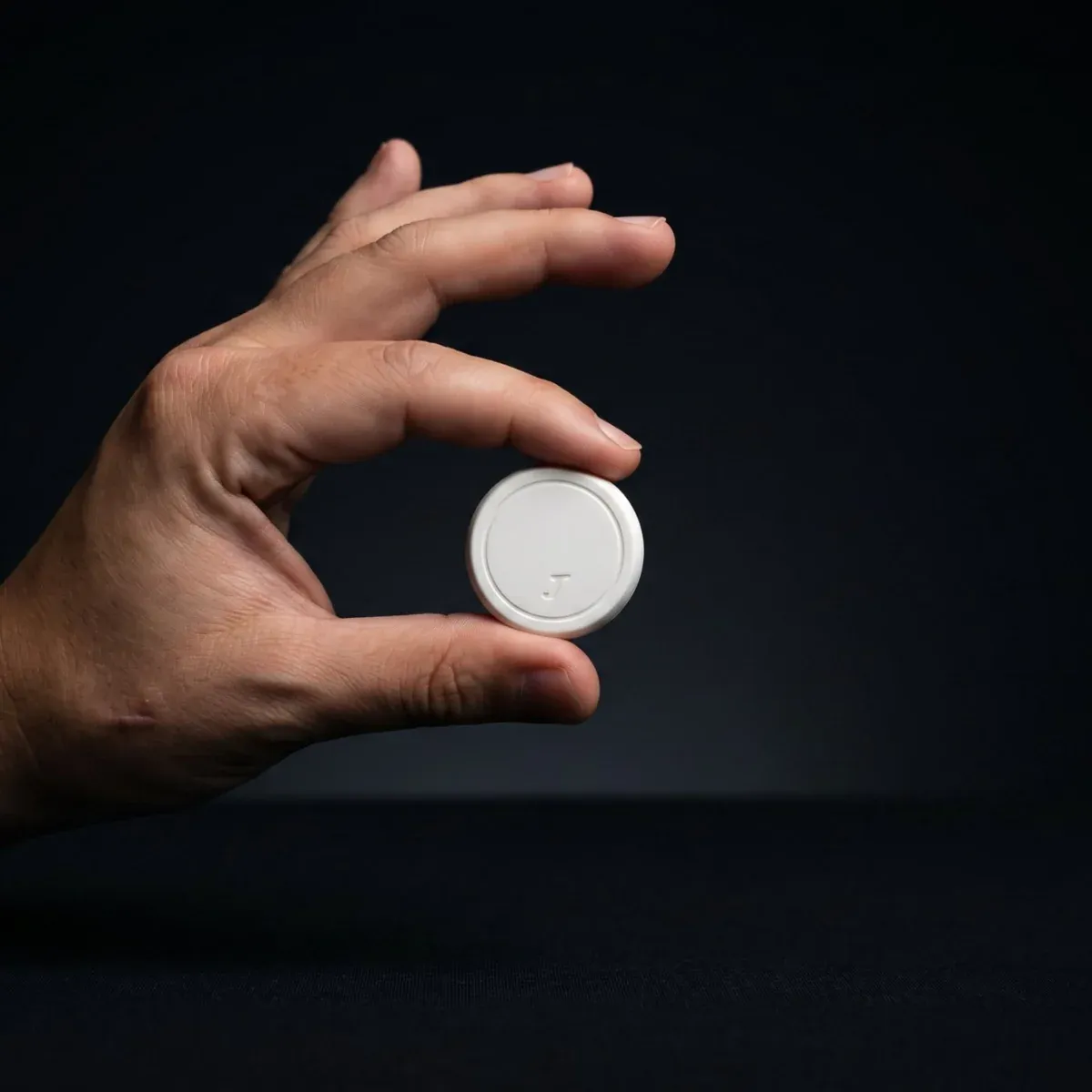
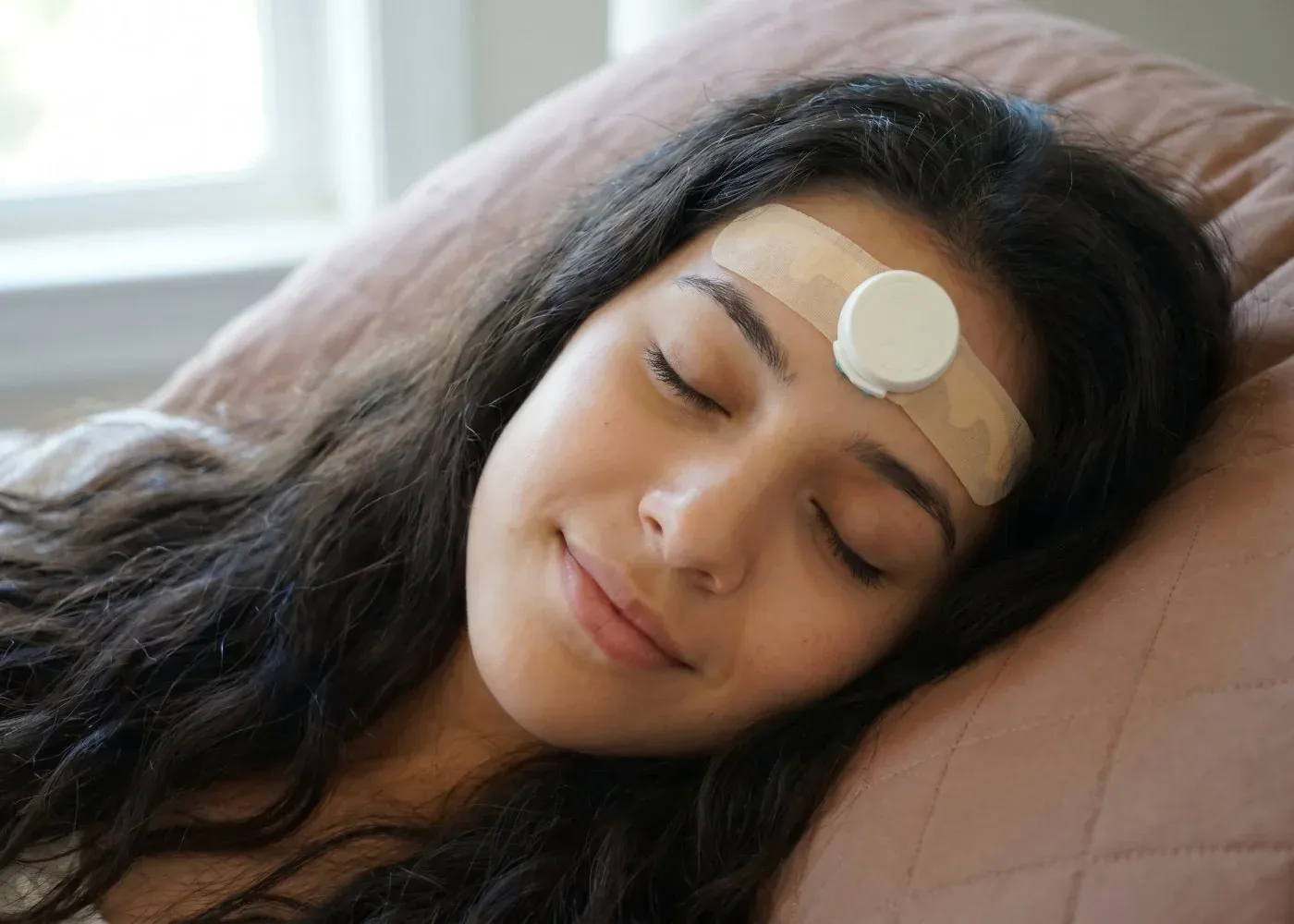
A forehead wearable records the jaw muscle overnight in the patient's own bed — the same signal a sleep laboratory scores bruxism from. Two nights, a report the patient can read without us, and a one-page summary written for your chair. Refer a patient for the Jaw Activity Assessment, or hold a device in your own practice.
What it measures, and why the forehead
Surface EMG of the anterior temporalis, from a forehead patch.
Grinding, clenching and bracing are behaviours of the jaw muscles, and surface EMG records them directly — including a jaw held tight and still. The anterior temporalis runs close under the skin of the temple; a sleep laboratory sees it as muscle artefact on the frontal EEG leads, and JawSense records it on purpose, from a forehead electrode patch, with a detection algorithm that separates jaw-muscle activity from brow and eye movement. Because temporalis EMG is what the research scores from, the numbers read in the same terms as the literature: how often, how long, how hard, night by night.
What lands on your desk
A night, written down.
Stronger episodes per hour, minutes in activity, and the peak against the patient's own calibration clench — for each of two nights, on one timeline, with the usable-signal figure and the exclusions stated. In plain language for your patient; one page in clinical terms for you, with the episode definitions and the limits on it. The same scale at baseline and every night after it.
What you get back
One night, sorted into grinding, clenching, or both.
Events
how often
Duration
how long
Intensity
how hard
Your Jaw Score is built from these three.
Illustrative example — not a recording.
What it is — and isn't
A wellness device that describes measured muscle activity.
JawSense ONE is CE and UKCA marked under the manufacturer's own declaration. It describes jaw-muscle activity recorded from the forehead in the patient's own bed. It does not diagnose, grade severity clinically, or treat, and it is not a substitute for a sleep study where a sleep disorder is suspected.
What it measures
Two-channel temporalis EMG from a forehead patch — both sides — through the night, both nights: episode counts, duration, and intensity relative to the patient's own calibration. Movement and pulse are recorded as context, not reported as sleep.
What your patient gets
Results in the app the morning after night two, a report to keep, and a fifteen-minute readout with the person who read the nights.
What you get
A one-page summary in clinical terms, brought in by the patient. Nothing leaves their hands without their say-so.
When to think of it
A measurement, where a measurement would change what you do next.
A guard still protects enamel. Physiotherapy still does what physiotherapy does. JawSense sits alongside: the number that says how much, when, and whether anything changed.
- Patients who grind, clench or brace, where a measurement would inform what you do next
- Patients wearing a guard — protection for the teeth, with nothing yet measured about the jaw
- Patients with TMD-type symptoms, before or during management
- Patients who want to know whether their nights are quiet — an answer we are willing to give
How a patient starts
Three ways in.
01
The Jaw Activity Assessment
Two nights at home with JawSense ONE. Kits ship in the Netherlands and Belgium first, the UK next; bookings open October 2026.
02
The app
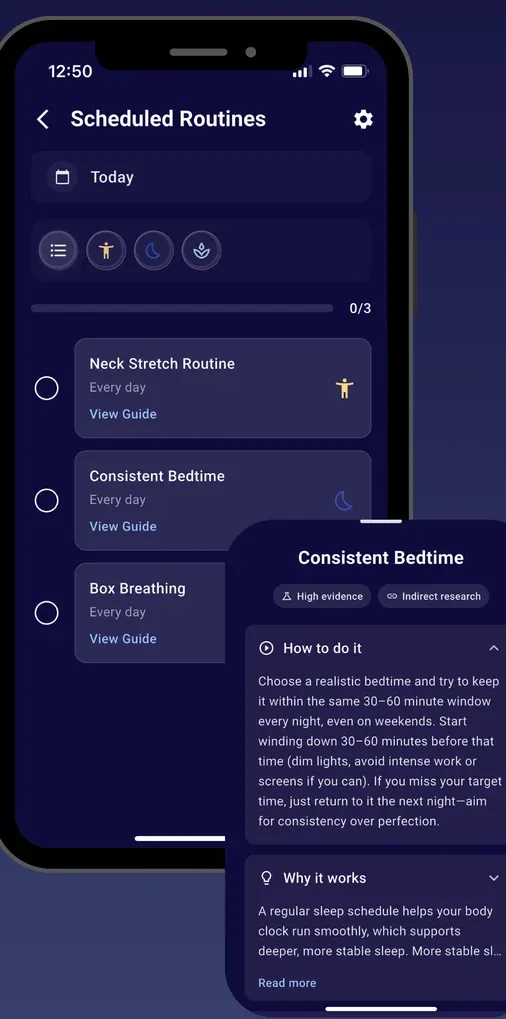
Free, iOS and Android, worldwide: awareness check-ins, a symptom and trigger diary, guided exercises and routines.
03
The Night Biofeedback Programme
Twelve weeks of cueing calibrated to the patient's own signal, every night measured. Run in small groups while we improve the training; it starts from an Assessment and is not sold on its own.
If you would rather run the measurement in your own practice, a clinic-held device with Assessment kits is possible. Talk to us
Who checks what we write
Reviewed before it reaches your patient.
A sleep physician, two dentists and a physiotherapist read the app's programmes, exercises and articles before release, each for their own field. Where the evidence is thin, the app says so.
The app — the free first step
For the daytime half, and for the patients you can't refer yet.
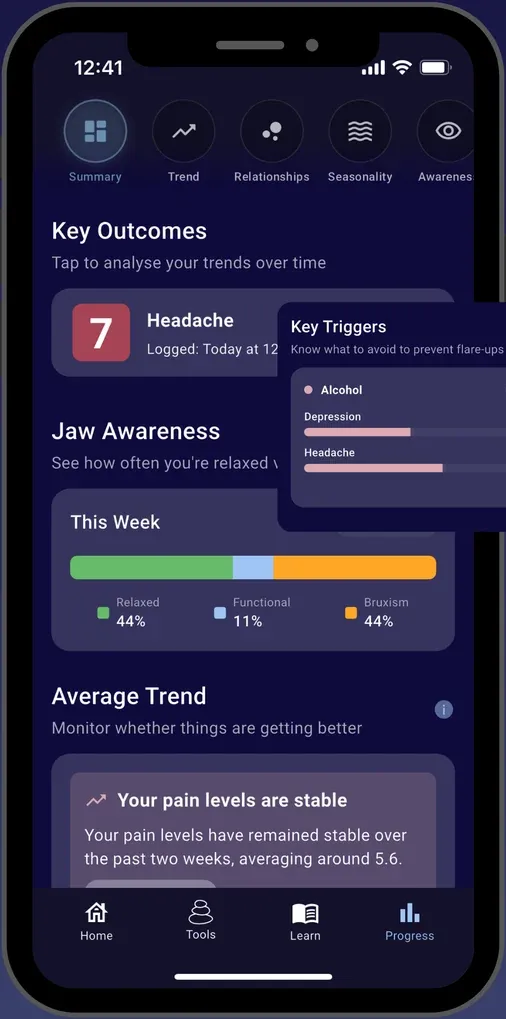
Awareness check-ins, a symptom and trigger diary, guided exercises and routines. Free, on iOS and Android, wherever the patient lives.
Noticing by day
Check-ins that catch clenching at the desk, and habit-reversal prompts that train the release.
A diary they can bring you
Symptoms, triggers and habits, summarised so the patient brings a pattern to the appointment instead of an impression.
Exercises with instructions
Guided sessions with an end date, including myofunctional exercises, in plain language.
Progress they can see
Completed sessions and week-on-week change — and whether they kept going.
Set against what you have now
Three ways to know what a jaw did last night
None of these is a rival to your examination. They differ in what they can put in front of you, and what it costs the person in your chair.
| What they tell you | A sleep-lab referral | A JawSense report | |
|---|---|---|---|
| Accurate dataHow close is it to what actually happened? | Recall of something that happened while they were asleep. | The clinical reference standard, for the night they were in it. | Jaw muscle activity, recorded at home and scored the same way every night. |
| Night to nightDo you see how much it varies? | One impression, formed over months. | Usually a single night. | Every night they record, on one scale. |
| The waitHow long before you have anything? | Nothing to wait for — it's what you already have. | A referral, then a waiting list. | The report is in the app the morning after the second night. A clinic-held device puts the kit in your patient's hands the same day. |
| What it asks of themWhat are you actually putting them through? | Nothing — and no answer either. | A referral first, then a waiting list, then one night in an unfamiliar bed. | Two nights in their own bed. No hardware to buy — kits are loaned and returned. |
| Before and afterCan you see whether your care changed anything? | Only whether they say it did. | In principle. In practice, rarely done twice. | The same method at baseline and every night after it, so a difference is legible. |
| On your deskWhat can you use inside the appointment? | Their account, and your examination. | A clinical report, if it reaches you. | A one-page summary written for you, brought in by the person it's about. |
It measures a behaviour, between your appointments, on a scale that repeats. Where a sleep disorder is suspected, polysomnography remains the reference.
Fair questions
Is this validated against polysomnography?
PSG with audio-video remains the clinical reference standard. JawSense measures the same muscle group over many nights in the home setting — a different, complementary picture. Our methods and limits are on the science page, and deeper studies are planned.
Is it a medical device?
No. JawSense ONE is a wellness device, CE and UKCA marked under the manufacturer's own declaration. It describes measured muscle activity; it doesn't diagnose or treat. Patients with pain, locking or other red flags are pointed to professional care — inside our quiz and app as well.
What does it cost my patient?
The app is free to start. The Assessment is €200, kit on loan, shipping both ways included. A clinic-held device with kits is priced separately — talk to us.
How is patient data handled?
GDPR-compliant, with the patient in control: reports belong to them, and they decide what to share with you. We don't sell data, and research use only ever happens with explicit consent.
Backed by






For clinicians
Refer a patient, or hold a device in your practice.
Write to Bas Borgdorff, co-founder and CEO — bas@jawsense.com — or use the form. We reply to every clinician ourselves.