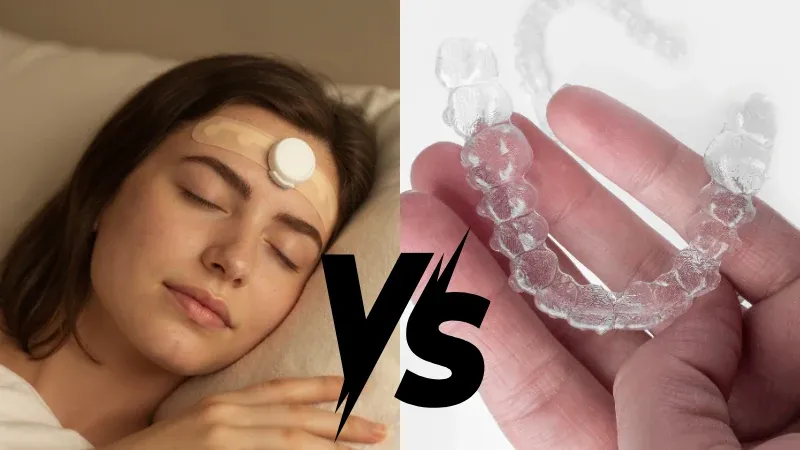
JawSense ONE
Biofeedback for bruxism: how you unlearn a jaw habit
Your jaw muscle tightens and you don't feel it — not until you have been doing it for hours and you are already sore. The JawSense ONE sensor catches you in the act and tells you, so you can let go straight away. Repeat that often enough and you are training a different default.
As Seen In





How it works
Notice it, release it, repeat.
Biofeedback means measuring something your body does that you can't feel, and showing it to you while it happens. Ours does that with the muscle that closes your jaw.
- 01
The sensor notices the clench
It reads the muscle that closes your jaw — including the quiet bracing that never makes a sound.
- 02
A cue, and you let go
Lips together, teeth apart, jaw heavy. About a second, awake or asleep.
- 03
Repeat until it's the default
Your jaw learned this. Enough repetitions and it learns to hold differently.
“It felt like someone lightly pulling the hairs above your forehead.”
What we built
A mini sleep lab that knows exactly when to nudge you.
01
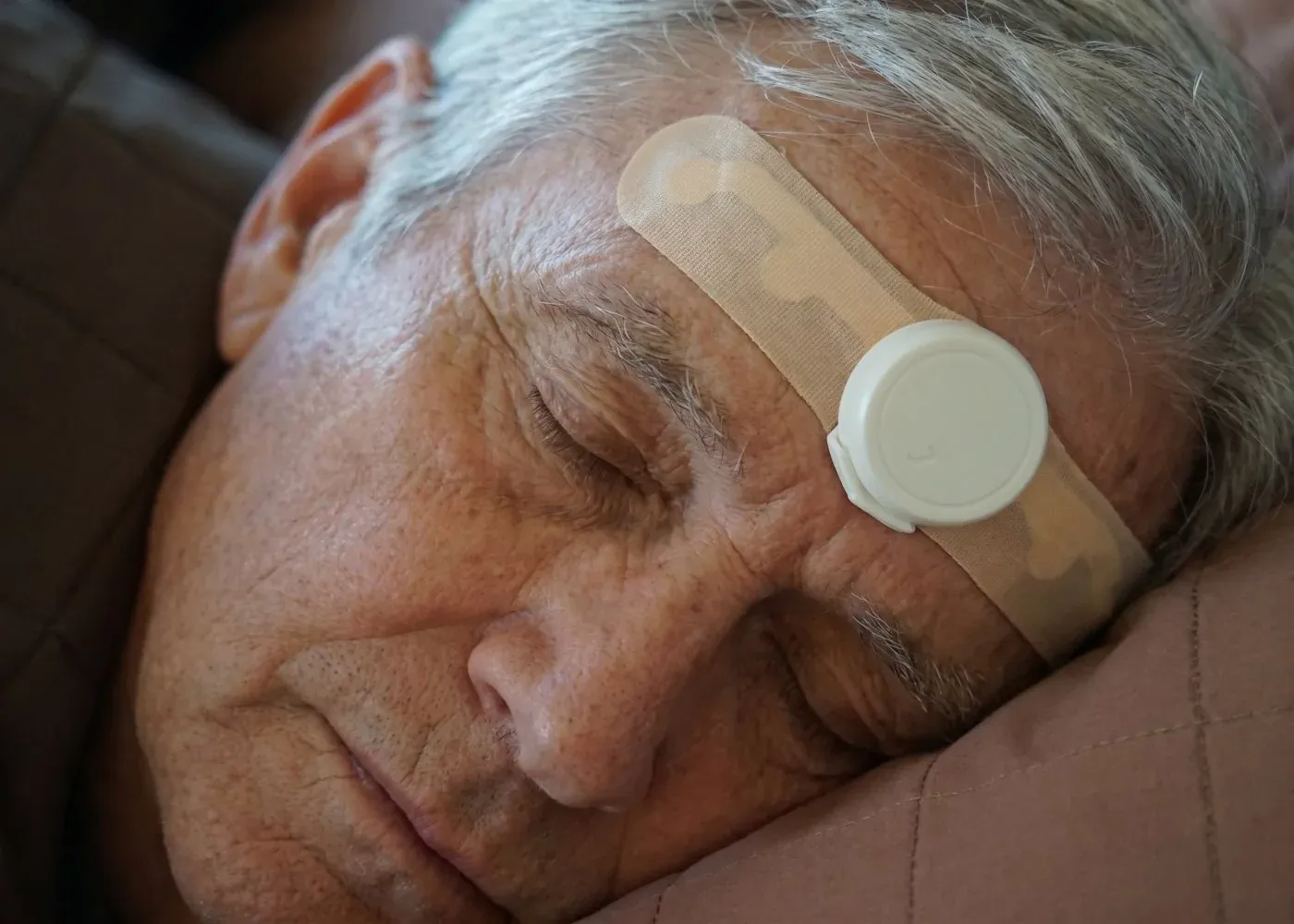
A smart sensor on your forehead
- It reads the tiny electrical signal your jaw muscle gives off.
- It watches your sleep, pulse and movement too — so it knows a clench from a toss and turn.
- The same signal a sleep lab scores, from your own bed.
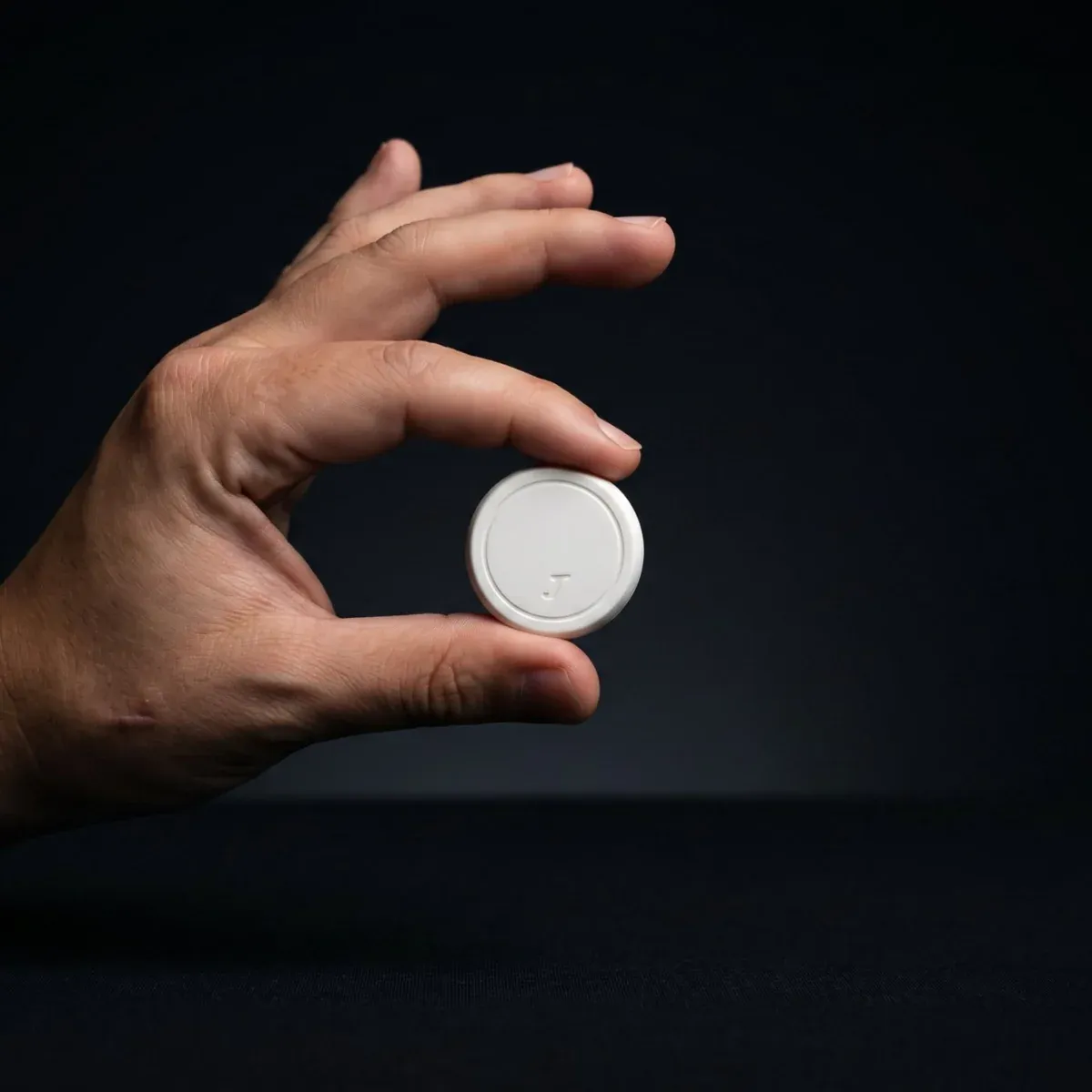 About the size of a €2 coin
02
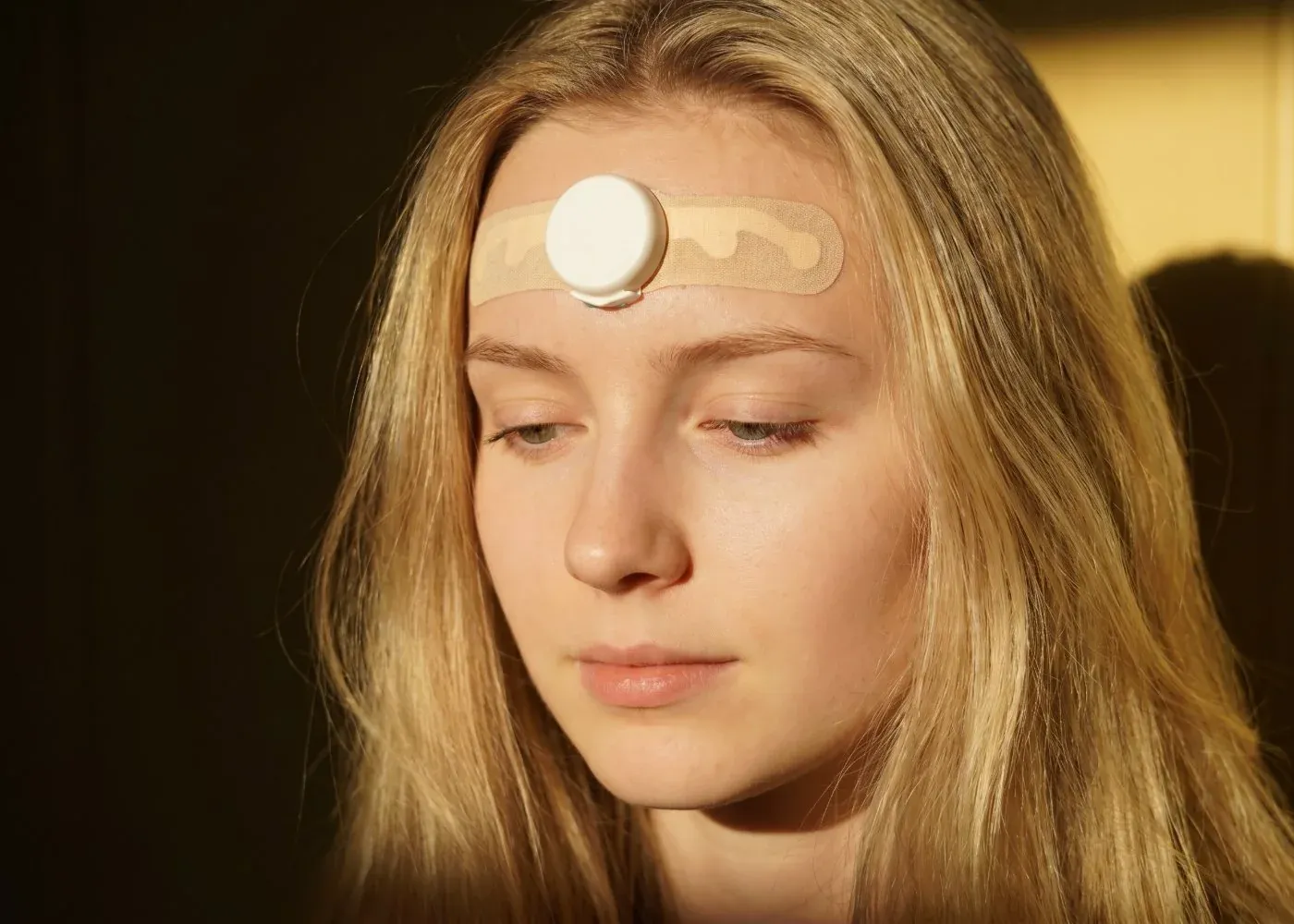
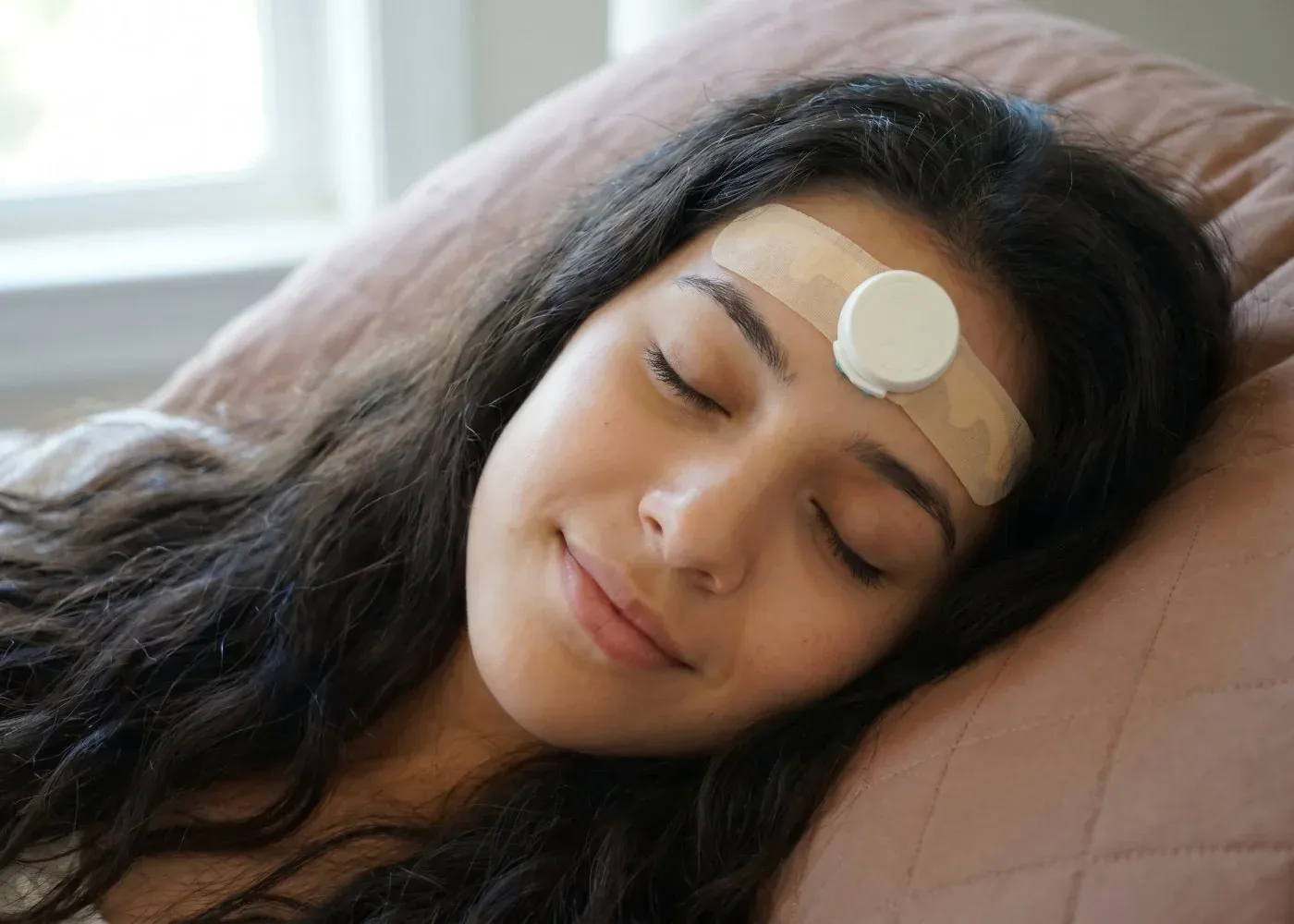
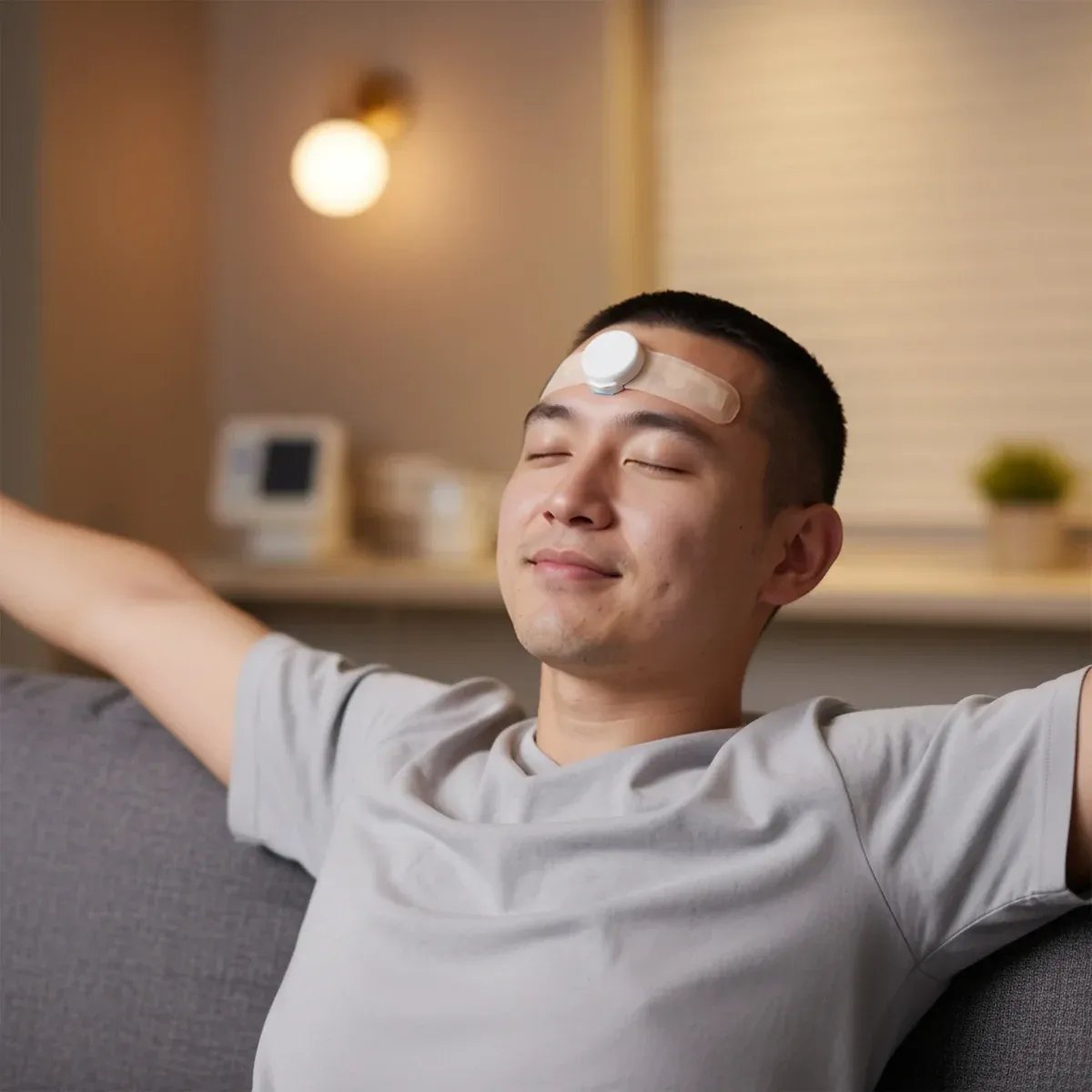
It clicks onto a soft patch
- Baby-grade silicone: comfortable to sleep in, lasts several nights, peels off in one move.
- Middle of your forehead — flat, comfortable, and not the side you sleep on.
- Nothing goes in your mouth.
03
Grinding, clenching, bracing — it tells them apart
- Even a jaw held tight and completely still shows up.
- Your teeth don't need to touch anything.
- Scored by algorithms we tested against sleep-lab recordings.
04
And it nudges you to let go
- Awake: a vibration you feel and act on.
- Asleep: a gentle pulse at a strength you set yourself — a light flick on the forehead, never a shock.
- Prefer to just measure? The biofeedback is optional.
“I was really surprised how easy it all was. It didn't bother me while sleeping.”
One real night
The three shapes your jaw makes while you sleep.
Grinding, clenching and bracing load the jaw differently — and only one of them makes a sound. Step through them and watch the muscle signal change.
Teeth sliding against teeth, mostly during sleep. The one a partner might hear. More on teeth grinding
What you get back
What one night looks like in the app.
The sensor records every hour you're asleep; the app has it sorted by morning. This is a real one — every cue laid over every episode.

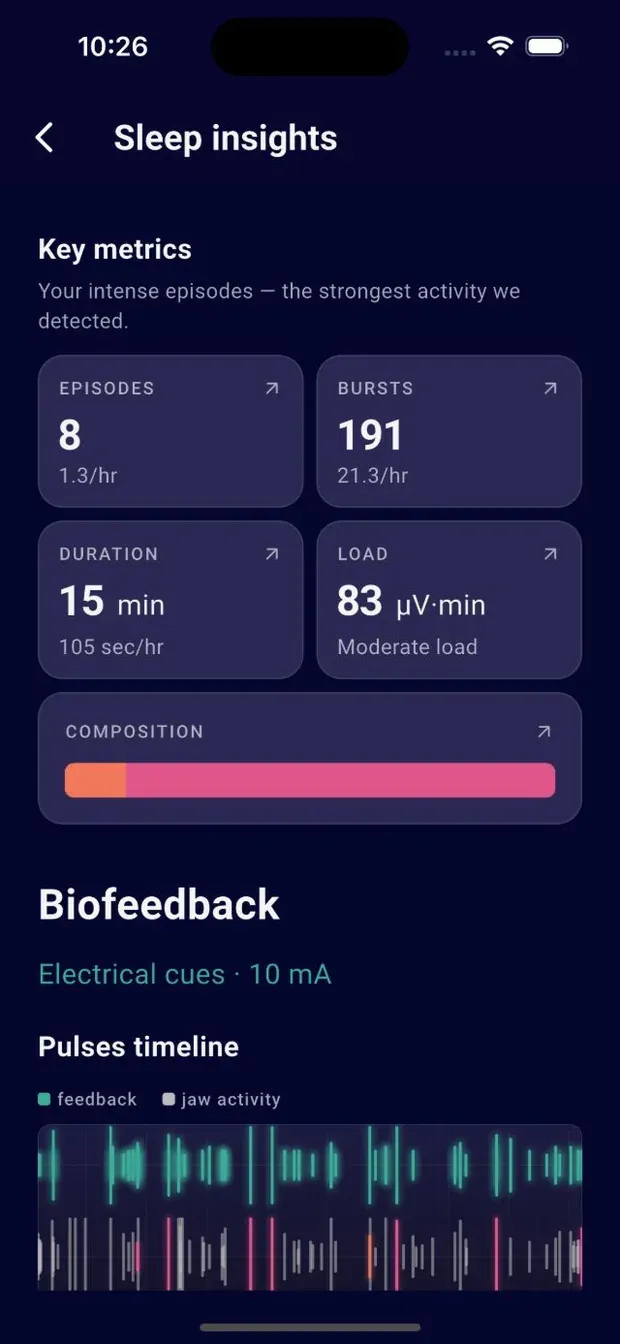
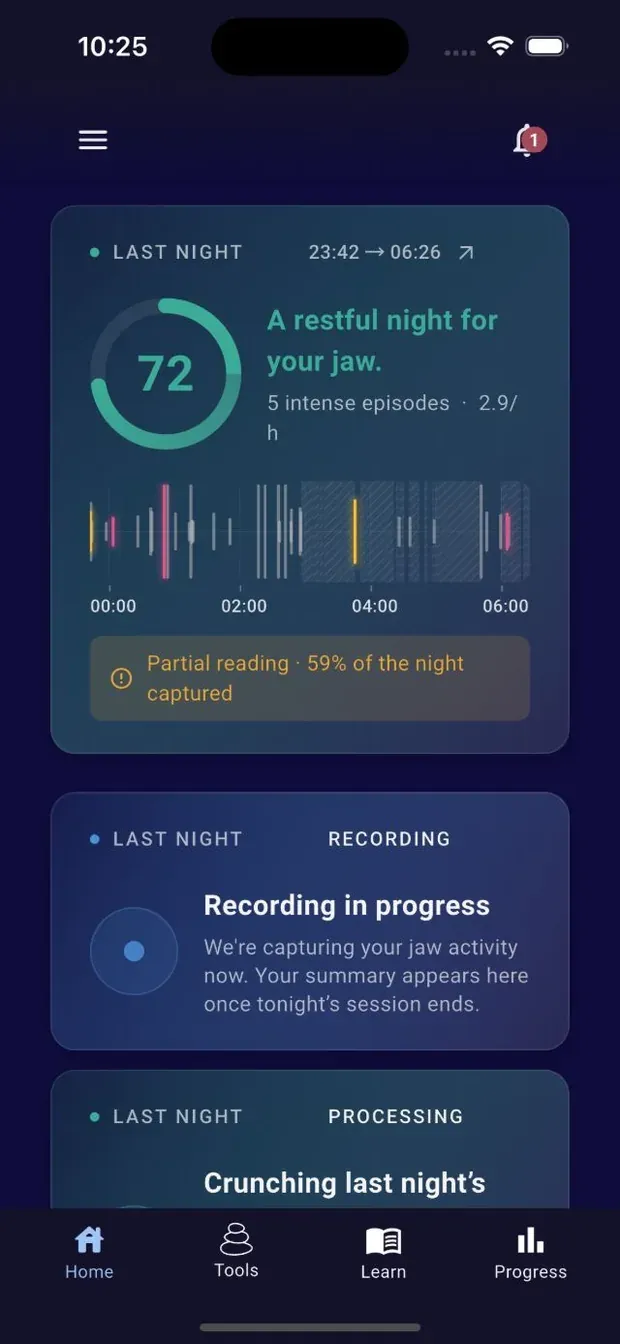
Measure, then intervene, then measure again — in that order.
“Finally insight, and a handle to start investigating what specifically helps.”
Does it actually work?
Forty years of research. Now in your bedroom.
This isn't new. Doctors have used biofeedback for grinding and clenching since the 1980s — it just never left the clinic, because nobody built a version you could wear to bed. Until now.
What we have seen ourselves
Our first cohort
10 of 10 spent less time in severe jaw activity on the night they were cued than on their own baseline night.
Ten people in our first cohort recorded a baseline night and a cued night we could compare directly. One night each, so we call it an early signal rather than proof.
How we measured it“I don't know if what I feel is a placebo effect, but it seems like my face is much more relaxed, and I woke up this morning very relaxed — as if I were very clear-headed.”
“I don't think there's anything on the market that addresses this problem — I'm not giving a 10 because the system has to prove itself over the longer term.”
And the research isn't ours alone: six independent studies since 1999, from sleep labs and dental journals, point the same way.
Promise is not proof, and one night each is not a trial. What every study actually measured — including the one where the effect faded once the cues stopped — is on the science page, limits included.
Read the evidence in fullThe comparison
So how is ours different?
Three ways biofeedback has reached a jaw, and what each one can and cannot see. Read down the questions on the left.
| In a clinic or sleep lab | A gadget that reacts to noise or motion | JawSense ONE | |
|---|---|---|---|
| The signalWhat is it actually reading? | Your jaw muscle itself — the same signal the research is built on. | Sound, or movement. Neither of those is the muscle. | The same muscle signal, from the same muscle group the research is scored from. |
| The silent clenchDoes it catch a jaw held tight and still? | Yes, on the night you're in there. | No. A held clench makes no sound and barely moves. | Yes, and that's the case it exists for. |
| How many nightsIs it one night, or your nights? | One or two, three to six months down a list, and €700–2,900 if you go privately. | Every night — of something that isn't the muscle. | Every night you wear it, scored the same way each time. |
| Where it happensDo you sleep like yourself? | No. Wired, off-site, and watched. | Yes. | Yes. A patch, and that's it. |
| Root causeIs it working on the habit, or on the damage? | The habit. That's what biofeedback has always been for. | Neither, reliably — it's reacting to a proxy for the habit. | The habit, with a cue at the moment the muscle tightens. |
| Before and afterCan you tell whether anything changed? | In a study, yes. In a course of care, rarely twice. | Its own counts, which drift with the room and the phone. | Every night of the twelve weeks, on the same scale as your baseline. |
| Five years onWhat do you actually know by then? | One or two nights, years ago, in a file you never saw again. | A pile of counts from something that isn't the muscle. | Every night you wore it, on one scale — and both ends of every programme you ran. |
A sleep lab remains the clinical reference standard; the difference is that you can wear this every night, at home. The ring or watch you may already be wearing reads your pulse and your movement: good at sleep stages, blind to a jaw.
Checked by doctors before it reaches you.
A sleep doctor, two dentists and a jaw physiotherapist read what we write before you do, each for their own field.
Meet the team


our clinical review team
How you get it
Start with the Assessment. Then the biofeedback programme.
01
1 · The Assessment
Two nights in your own bed, so we know what your jaw actually does. If they come back quiet, we say so.
02
2 · The Night Biofeedback Programme
Twelve weeks of biofeedback tuned to your own jaw, in small groups while we keep improving the training. Your Assessment is the starting point we measure against.
03
3 · Calls along the way
A setup call to get your cues right, and three calls across the twelve weeks to look at your nights together.
Backed by & built with










Common questions
Biofeedback FAQs
The next step
So: do you think biofeedback is for you?
There is one way to find out, and it isn't reading more. Two nights in your own bed tell you how much your jaw actually does — how often, how long, how hard. A lot, and the twelve-week programme is the next step. Quiet, and we'll tell you that instead.
two nights, your own bed
Pre-registering costs nothing and commits you to nothing · two measured nights, in your own bed
“I've been dealing with night-time teeth clenching since I was a teenager — I'm now 40. I've tried everything including Botox. JawSense is the first bit of hope I've had in ages.”


Available now, free
The JawSense app — your daily companion.
The programmes are twelve weeks. The app is every day: guided routines, a symptom and trigger diary, and the release work you can do at a desk. It is free, it works without the sensor, and it is where most people start.
- 18 programmes, from check-ins to relaxation and habit change
- A symptom and trigger diary, with summaries you can hand to your dentist
- Built on what the international guidelines for bruxism and TMD recommend you do yourself



From the Blog
Learn More About Biofeedback
Articles on jaw tension and biofeedback, with the studies named