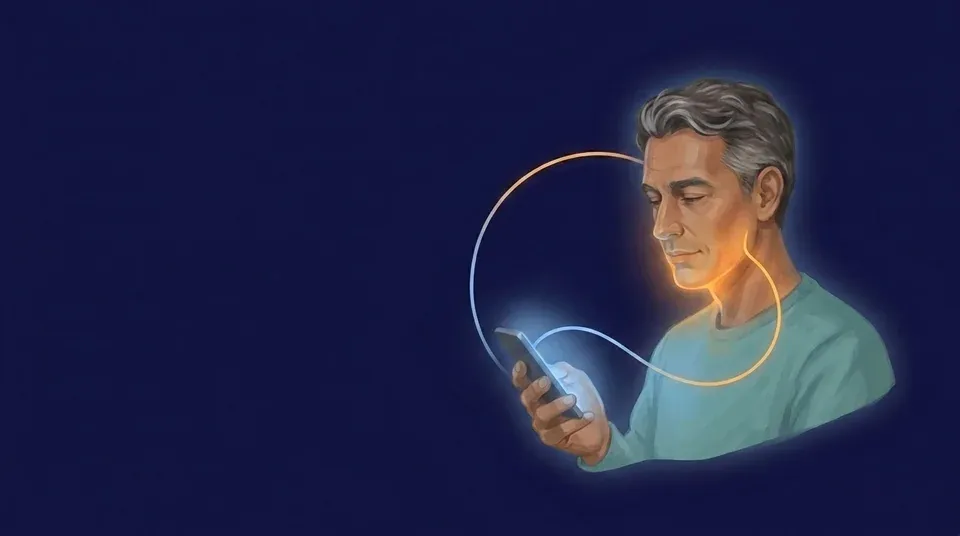
Biofeedback training is a way of learning to change something your body does on its own. A sensor measures it, a signal tells you the moment it happens, and because you now know, you can do something about it. Your heart rate, your breathing, the tension in a muscle: things you normally cannot feel, made visible while they are happening.
This guide covers what biofeedback training is, how it works, the main types, what it is good at and what it is not, and the difference between doing it in a clinic and doing it at home. At the end there is a section on the question people arrive here with most often: whether it works for teeth grinding.
What is biofeedback training?
Most of what your body does, it does without asking you. Your heart speeds up, your breathing shallows, a muscle tightens, and you find out later, if at all. Biofeedback closes that gap. A sensor measures one of those functions, and you get the measurement back in real time: a number on a screen, a tone, a buzz, a light. The signal is the feedback. The training is what you do with it.
It is a skill, not a fix. Nobody can relax a muscle they cannot feel, so the first job of the feedback is simply to show you when it is working. The second is to let you try something — breathe out, let the shoulders drop, let the jaw hang — and see, immediately, whether it helped. Repeat that enough times and the noticing starts to happen without the sensor.
It is non-invasive and it involves no medication. It sits alongside whatever else you and your dentist or doctor are doing, not in place of it.
How does biofeedback training work?
The loop is the same whatever is being measured:
- A sensor picks up the signal. Electrodes on the skin for muscle or brain activity, a clip or a band for heart rate and breathing, a small probe for skin temperature.
- A threshold is set. Nothing happens until the signal crosses it: the muscle tightens past a certain level, the heart rate climbs past a certain point.
- You get the cue. As soon as the threshold is crossed. A beep, a bar rising on a screen, a vibration.
- You respond. You let go, slow down, or change what you were doing. The sensor keeps measuring, so you can see whether the response worked.
- Repeat. Many times, over sessions, until the response starts to arrive before the cue does.
What is well established is what happens while the feedback is running: the measured signal changes. What is less established is what happens after it stops. Whether the new response holds, and for how long, is the open question in this whole field, and it is the one we are trying to answer with our own recordings.
Types of biofeedback
Biofeedback is named for what it measures.
- Muscle activity (surface EMG). Electrodes on the skin over a muscle read the electrical activity of the fibres underneath. This is the most common form, and the one used for the jaw, the neck and the shoulders — muscles that tighten without you noticing.
- Brain activity (EEG, also called neurofeedback). Sensors on the scalp read patterns of electrical activity, and the training aims to shift those patterns.
- Heart rate and breathing. Heart rate, heart-rate variability and breathing rate, used when the aim is to bring the body down from a state of alarm.
- Skin temperature and skin conductance. Both change with stress without any conscious input, which makes them useful signals for relaxation training.
Each one tells you something different, and which one is used depends on what is being worked on.
What it is good at, and what it is not
Biofeedback is good at one thing: showing you a behaviour you could not otherwise see, at the moment you could change it. For a habit like clenching, where the whole problem is that you do not know you are doing it, that is exactly the missing piece.
It is not a substitute for a clinician. If something needs a dentist, a doctor or a physiotherapist, it still needs them, and biofeedback works alongside that rather than instead of it. It is also not passive: it asks you to respond to the cue, every time, over weeks. A signal you ignore trains nothing.
The risk side is low. The sensors sit on the skin and measure; the cues are designed to be noticed, not to hurt. The main cost is your attention.
Clinical vs at-home biofeedback training
Biofeedback grew up in clinics. A therapist attaches the sensors, a screen shows the signal, and you learn what "let go" feels like by watching the line fall. Sessions run half an hour to an hour, weekly, for some weeks, and between sessions you are on your own.
That is changing, because the sensor no longer has to be in a clinic. Small wearable sensors, a phone as the screen, and a cue in place of the therapist mean the training can happen where the habit does: at your desk, in your car, in your own bed. The trade-offs are real in both directions. A clinic gives you an expert watching the signal with you; home gives you many more sessions, in the situations that actually trigger the habit, at a fraction of the cost. For a behaviour that happens all day or all night, the second matters more than it sounds.
JawSense ONE is a small forehead sensor that reads the muscle closing your jaw and gives you a gentle nudge the moment it tightens — so you can notice the clench and let it go, at home rather than in a clinic.
Does biofeedback work for teeth grinding?
Published trials report that jaw muscle activity falls while a cue is being delivered; whether it stays down afterwards is far less well studied, because almost no trial has followed anyone for long enough to find out.
Here is what sits behind that.
A systematic review and meta-analysis of biofeedback for sleep bruxism found that episode frequency dropped significantly against placebo devices after five nights, without disturbing sleep architecture — and rated that evidence low to moderate in quality, because the samples were small and the methods too varied to pool confidently (Jokubauskas & Baltrušaitytė, 2018). A 2022 systematic review of sleep bruxism management reached the same shape of conclusion across biofeedback, splints, medication and botulinum toxin, and asked for larger and longer randomised trials before any of them can be called settled (Minakuchi et al., 2022).
On the daytime side, a small randomised study of EMG biofeedback for awake clenching — seven people in the training group — found tonic muscle events fell during the training week and stayed lower the week after, and reported a knock-on reduction at night too (Sato et al., 2015). Seven people is seven people, and the study ran for three weeks.
A few studies have looked past the end of the cue, and they are the reason this question is open rather than closed. A three-month randomised trial of a biofeedback splint found that after the three months ended, the average and maximum duration of bruxing bursts stayed significantly lower — but their frequency did not (Bergmann et al., 2020). Sato's participants were still showing fewer events a week after training ended. So something carries over in some measures, in some people, for some period.
On the question people ask most — will it wake me — a sleep-lab study of cues delivered at a non-painful intensity found no significant effect on total sleep time, micro-arousals, deep sleep or REM (Jadidi et al., 2011).
What nobody has done is follow people for long. These are trials of nights and weeks, occasionally three months. The question everyone actually wants answered — does the jaw keep a new default a year later, without the device — would need a study that runs for a year with people who have stopped using anything, and that study has not been run. The gap in the evidence is a gap in study length, not a finding that the effect disappears.
Those results belong to the devices that were tested in them, not to ours. We are recording our own and will publish them with the same hedges attached.
Conclusion
Biofeedback is a way to see something your body is doing and practise a different response, while it is happening, until the response starts to come on its own. It works alongside whatever else you are doing, and it asks for your attention rather than your trust.
The sensors are now small enough to leave the clinic, which means the training can happen where the habit does. For the jaw, that is the difference between an hour a week with a therapist and every night in your own bed.
Curious about jaw biofeedback? Learn about JawSense ONE or explore the JawSense app.