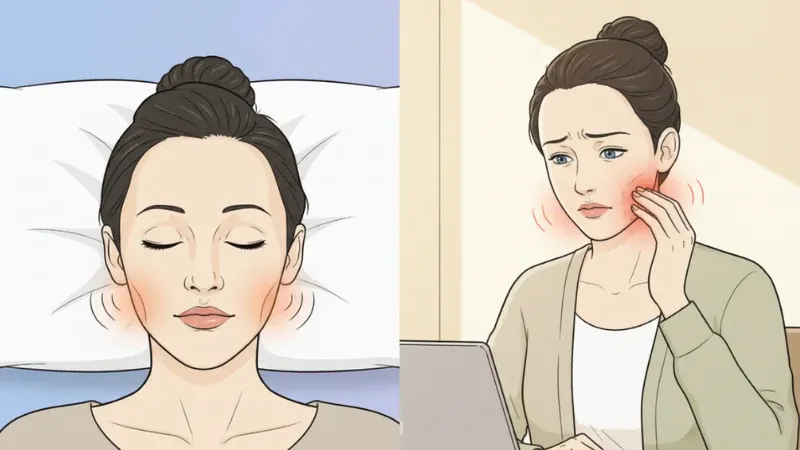
You can catch daytime clenching yourself, because you are awake when it happens; night-time grinding has to be measured, because you are not. That is the whole difference between the two, and it decides what each one needs.
Bruxism comes in two forms that share a name but differ in almost every other way. Sleep bruxism occurs during sleep as an involuntary motor behaviour. Awake bruxism happens during waking hours, typically as unconscious clenching during concentration or stress.
The distinction matters because the two halves involve different brain mechanisms — and what works for one can fail entirely for the other.
How to tell which one you have
Four questions usually settle it:
- Does a bed partner hear grinding at night? (suggests sleep bruxism)
- Are mornings the worst time for jaw soreness? (suggests sleep bruxism)
- Do symptoms worsen during stressful work periods? (suggests awake bruxism)
- Does clenching happen during concentration, driving, or emotional moments? (suggests awake bruxism)
Many people have both, which needs both answers rather than a choice between them.
At night: the half you can't catch
Grinding and clenching at night cluster around the moments when sleep lightens — the brief shifts between stages that everybody has and nobody remembers.
Key characteristics:
-
Below conscious reach: it is generated by parts of the nervous system you have no conscious access to, which is why willing it away doesn't work (Lavigne et al., 2008).
-
Micro-arousal triggered: Episodes typically occur during brief arousals—shifts toward lighter sleep where the brain becomes momentarily more active. Research shows a characteristic sequence: cardiac acceleration → brain arousal → muscle activation → grinding (Kato et al., 2001).
-
Not something you can will away: Willpower and self-directed check-ins can't reach it, because you aren't awake to use them. A gentle cue during those lighter phases can, which is the route night-time biofeedback takes.
-
Rhythmic pattern: Often presents as rhythmic grinding with audible sounds, though tonic (sustained) clenching also occurs.
Prevalence: Roughly 21% of adults grind or clench in their sleep, and higher again when it's measured objectively rather than asked about — the same meta-analysis puts the sleep-lab-measured subgroup far above the self-reported one. Rates are highest in younger adults and decline with age (Zieliński et al., 2024).
By day: the half you can
Awake bruxism typically presents as sustained clenching, jaw bracing, or teeth contact during waking hours. Unlike the night-time kind, it happens while you're there to notice it.
Key characteristics:
-
Within reach: the daytime kind happens while you're awake, so it can be caught and changed through awareness and behavioural training (Bracci et al., 2024).
-
Linked to stress and concentration: Often occurs during focused work, emotional tension, or stressful situations. The behaviour may serve as an unconscious coping mechanism.
-
Unconscious but modifiable: People typically don't realise they're clenching, but once aware, they can voluntarily relax. This makes awareness training effective.
-
Sustained pattern: Usually presents as prolonged clenching rather than rhythmic grinding. May also include jaw bracing without tooth contact.
Prevalence: Roughly 20–30% of adults clench or brace their jaw while awake — more than grind in their sleep, likely because waking hours simply offer more opportunity for it (Zieliński et al., 2024).
Why what works for one fails for the other
The different brain mechanisms mean an approach aimed at one half can be irrelevant to the other.
For sleep bruxism
Because night-time activity is generated below conscious reach:
- Awareness techniques work differently: Sleep clenching happens during micro-arousals (lighter sleep phases). A gentle cue during those phases can prompt the jaw to soften without fully waking you. That's a different route from conscious daytime awareness, and the honest position on it is that activity falls while the cue is running; whether anything holds once it stops is still open.
- Night guards protect but don't reduce: Splints prevent dental damage but don't address the underlying motor pattern. This is what dentistry currently offers.
- The research is decades old; the products aren't: cue-based approaches during sleep have been studied since the 1990s and the direction of that work is consistent. The devices that ran those trials came and went, which is why there is a gap between the science and what you can actually buy.
- One night isn't enough: activity swings a lot from night to night, and what you remember in the morning is a poor guide to what happened. Several nights of measurement is what settles it when self-report is uncertain.
For awake bruxism
Because the daytime half happens while you're there to notice it:
- Awareness training is foundational: Regular check-ins throughout the day (like JawSense's Jaw Awareness prompts) build conscious recognition of an unconscious habit.
- Biofeedback can interrupt the loop: Real-time feedback when clenching is detected prompts voluntary relaxation, training new responses over time.
- Stress management helps: Since stress and concentration amplify the behaviour, addressing these factors provides supportive benefit (though rarely eliminates the habit alone).
- Noticing is available by day: you can catch daytime clenching through structured awareness practice. During sleep, wearable biofeedback provides the monitoring and cues automatically.
Four ways people get this wrong
Handling both halves the same way. A night guard bought by someone whose main problem is daytime clenching won't address it. Daytime check-ins aimed at heavy sleep grinding leave the real issue untouched just as completely.
Relying only on verbal advice for sleep bruxism. Telling someone to "relax before bed" or "be aware of jaw tension" isn't enough on its own. Wearable biofeedback that delivers gentle cues during micro-arousals can help where verbal advice alone falls short.
Filing the daytime half under "just stress." Daytime clenching is its own habit with its own triggers, and it doesn't reliably go away when life calms down.
Relying solely on splints for either type. Night guards protect teeth but don't address behaviour. For comprehensive management, protection should be combined with approaches targeting the underlying pattern.
The bottom line
Sleep bruxism and awake bruxism share a name but involve different brain mechanisms, which is why they need different answers:
- At night: generated below conscious reach, so the noticing has to come from a sensor — the options are protecting the teeth and, increasingly, biofeedback that cues the jaw while you sleep
- By day: below your notice but within your reach — it responds to awareness training and biofeedback
It starts with knowing which half — or which halves — you have, and choosing accordingly.