Most people meet their jaw through a symptom that isn't obviously about the jaw at all.
A headache that is already there when you wake up, sitting at the temples. An ear that feels blocked, or rings, and comes back clear from every examination. A tooth that aches convincingly enough to earn a filling it never needed. A neck that will not let go no matter how many times you roll your shoulders.
These get treated separately, by different people, and often none of them work. The reason is worth understanding, because it changes what you'd sensibly do next.
One nerve, one very crowded junction
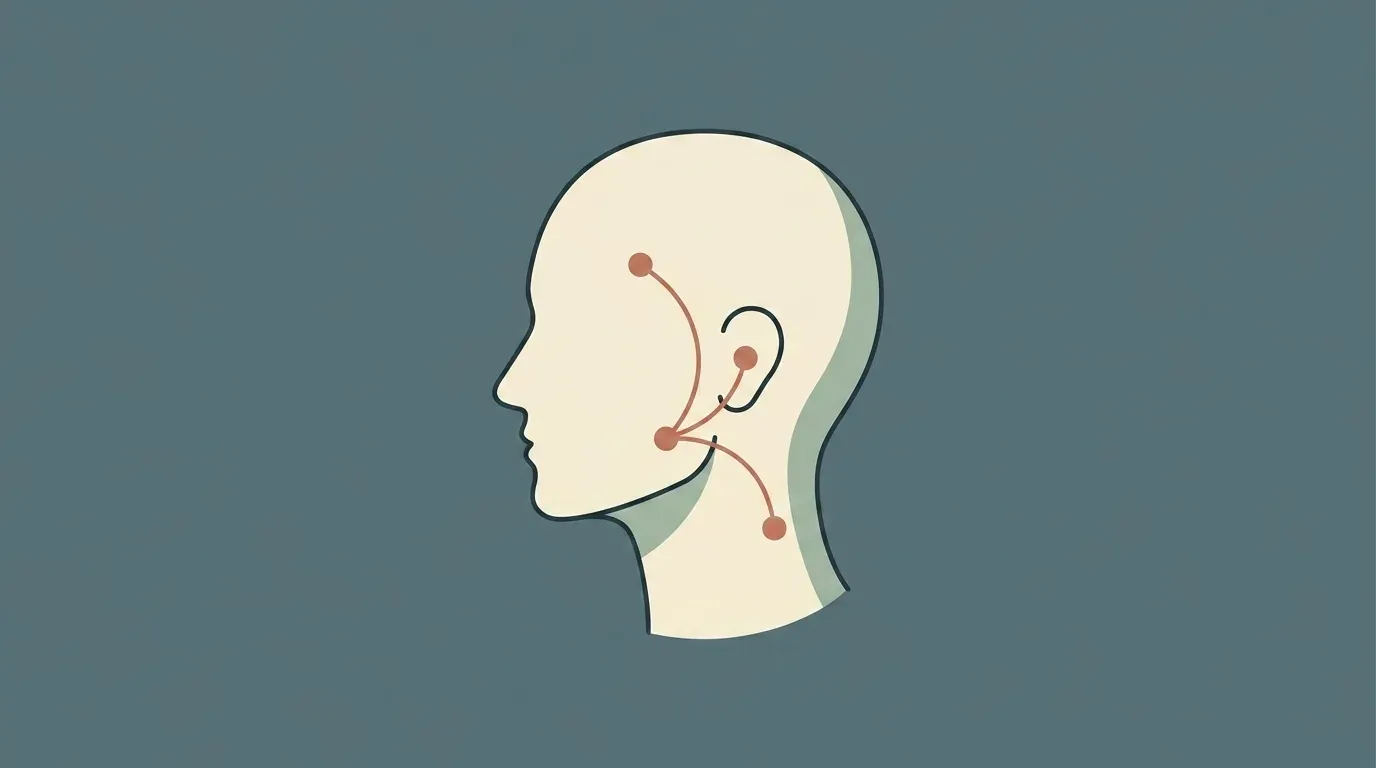
One big nerve carries sensation from your jaw, your teeth, your face and your sinuses — and it shares a destination with nerves from the top of your neck. Both streams arrive at the same small cluster of cells, and it can't always tell you which one sent what.
That convergence is not a design flaw. It's how the system is built, and most of the time it works fine. But it does mean the brain receives jaw signals and neighbouring signals through the same door, and it is not always able to tell you precisely which room the noise came from.
So a muscle working overtime at the angle of your jaw can be experienced at the temple. Or behind the eye. Or in a tooth. The location you feel is not always the location that's working.
What that looks like in practice
Temples and behind the eye. The temporalis is a broad fan of muscle across the side of your head, and it is one of the main muscles that clenches. When it stays busy for hours, the ache it produces is felt exactly where a tension headache is felt — and often across the brow, which is why it gets mistaken for sinus trouble.
The ear. Several jaw muscles sit close to the ear, and the joint itself is a near neighbour. Fullness, a low ache, or ringing with a clear examination is a familiar pattern to clinicians who look for it — and an invisible one to those who don't.
Teeth. Referred toothache is the most expensive version of this. The pain is real, the tooth is fine, and the dentistry doesn't help because the source was never in the tooth.
Neck and shoulders. This one runs both ways. A jaw almost never braces on its own — the neck and upper traps brace with it, and they share that junction, so each can keep the other going.
The honest caveat
Referral is a contributor, not a diagnosis.
Headaches, ear symptoms and neck pain all have plenty of other causes, several of which matter more and need proper attention. Nothing here says your headache is definitely your jaw. What it says is that jaw loading belongs on the list of things worth ruling in or out — and that it is routinely left off, because the person looking at your ear isn't looking at your jaw.
If symptoms are severe, one-sided, changing, or new, see a clinician first. This is context, not triage.
Why it's hard to catch yourself doing it
The obvious response is: fine, I'll stop clenching. Except that a large part of this happens while you're asleep, or while you're concentrating hard enough that you have no idea you're doing it. You cannot correct a behaviour you cannot observe.
That is the gap. Not motivation — information. Most people trying to sort out their jaw are working from guesses about what it does when they aren't watching, and are then sold an intervention based on that guess.
The thing your jaw does that a knee doesn't
There's one more reason this matters more than it sounds.
Load a knee badly and you can rest it. Take the stairs slowly, skip the run, let it settle.
You cannot rest your jaw. You breathe with it, talk with it, eat with it, yawn, laugh, kiss and hold your face together with the same muscles — thousands of times a day, whether they're sore or not. A muscle system that never gets a proper day off has to be worked with rather than paused.
That's the whole argument for measuring before you intervene: if you can see what your jaw is actually doing — when it's busy, how long for, what preceded it — you can make a decision instead of a guess.
Curious what yours does at night? The 2-minute jaw quiz is an honest starting point, and the science behind our approach sets out what's established and what isn't.