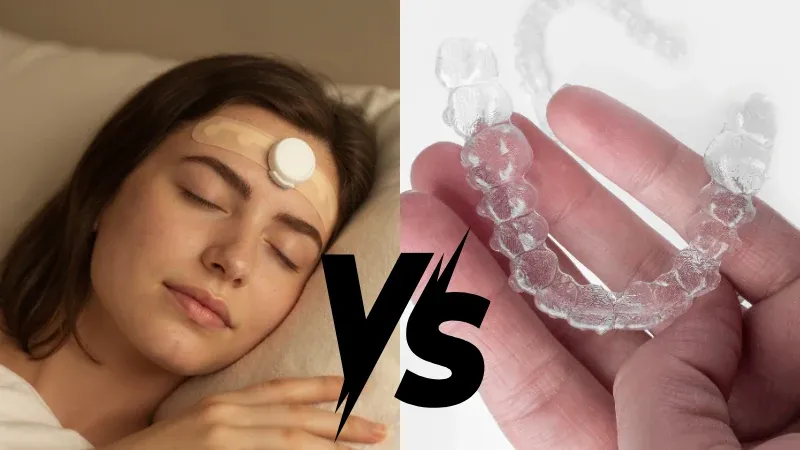
Clench Alert cues you when your teeth press together during the day; JawSense measures what your jaw muscle does, day and night, and cues on the muscle itself. They answer different questions, which is why the comparison is worth making properly rather than as a scorecard.
Last reviewed: 17 September 2026. Everything below about Clench Alert comes from clenchalert.com on that date; if their product changes, tell us and we will update this.
What each one is
Clench Alert is a small device that sits inside the mouth. When it detects pressure — your teeth coming together — it vibrates, and the idea is that you notice, release, and reset to the resting position its maker sums up as "lips together, teeth apart". It is made for awake daytime use, in sessions its site suggests starting at fifteen to thirty minutes once or twice a day. It has no app and no connection to one — "no app, charging cable, Bluetooth pairing, or technology setup required", in its own words — so it cues, and what it noticed is not kept anywhere. It costs $97, is sold from the United States, and comes with a thirty-day return window. Its site is careful to say it is a wellness product and not intended to diagnose, treat or prevent anything.
JawSense ONE is a sensor worn on the forehead. It reads the electrical signal of the muscle that closes your jaw — the same signal a sleep lab scores — so it registers clenching whether or not the teeth touch, and it records what it reads. It has a day mode, where a cue arrives when the muscle tightens, and a sleep mode, where a gentle pulse at a strength you set is designed to reach the muscle without waking you. What it reads goes to the app, which also works without the sensor: check-ins, exercises, a diary. It is a wellness product, not a medical device, and it does not diagnose or treat anything either. How it works has the detail.
What each one measures
This is the real difference, and it is not a matter of better or worse.
A pressure cue answers one question: are my teeth together right now? That is a useful thing to know while you are at a desk, and a nudge at the moment it happens is the mechanism the awareness literature is built on.
But a lot of what people call daytime clenching is not teeth pressing together at all. It is bracing: the jaw held tense with the teeth slightly apart, the muscles loaded and nothing touching (Lobbezoo et al., 2018). It is the one almost nobody knows they do, because there is no contact to notice — and a device that waits for tooth contact never sees it either. Hours of it can pass without a single cue.
A muscle sensor answers a different question: how hard is my jaw working, and when? It reads the muscle, so bracing and clenching look the same to it. A muscle signal also has a size, a duration and a time of night, which is what turns a cue into a measurement. You can look at last night and see it.
Neither device measures pain, sleep quality, or whether your jaw is "damaged". Both are about the behaviour.
Day, night, or both
Clench Alert is a daytime product by design; its site says plainly that it is not for sleep. That is a fair choice, and it fits people whose problem is a desk-hours habit.
It also means it cannot tell you about the other half. Most jaw activity happens during sleep, clustered around brief arousals you do not remember (Kato et al., 2001), and it is silent — no teeth-on-teeth sound, no sensation, nothing to notice. If you wake with a sore jaw or a headache, the daytime cue was not switched on when the work was done. The honest sequence for that person is to find out what the nights hold before deciding what the days need, and a measurement is the only tool that does it.
The evidence
There is no published study of either device by name, and it would be misleading to imply otherwise for ours.
What exists is evidence for the approach. A 2023 systematic review of randomised trials found that biofeedback produced large reductions in daytime jaw-muscle activity, with two days of auditory biofeedback enough to measure a change — from small trials, with the authors warning that use beyond four weeks may bring habituation and that the long-term picture is open (Vieira et al., 2023). That review is about EMG biofeedback in research settings, not about a pressure cue and not about a consumer wearable; it tells you the mechanism is real, not that any product delivers it.
Clench Alert's site cites no studies. JawSense's scoring algorithm has been validated against polysomnography-scored recordings, scored the way a sleep lab scores them; the full system — our wearable and our algorithm together, against a sleep lab, on the same nights — has not been done yet, and the biofeedback page says so in as many words. When we have that, we will publish it with the same hedges.
What you are paying for
Clench Alert's $97 buys a cue you own, with nothing to set up and, by its own design, nothing to look at afterwards. With JawSense the sensor is not something you buy: it comes with a two-night measurement of what your jaw does, on loan, and the app's check-ins do a version of what the daytime cue does — a prompt to notice where your jaw is — with no hardware at all. So the comparison is not one price against another. It is a cue you keep, against a measurement you take and an app you already have.
Which question is yours
If your problem is the daytime habit — you catch yourself tight over email, your jaw is fine in the mornings — start with the thing that is with you all day. The check-ins in the JawSense app are free to start, need nothing in your mouth or on your head, and run through your whole day rather than a session of it: a prompt to notice where your jaw is, let go, and slowly make the relaxed position the default. That is the same notice-and-release mechanism a cue is built on, without hardware.
A cue can add to that. Before you buy one, ask the honest question: are you clenching, or mostly bracing? If your teeth are rarely together, a contact cue has nothing to fire on, and the sensor that would catch you is one that reads the muscle. Worth knowing too: anything held in the mouth for a long stretch is itself something the jaw has to hold — one reason Clench Alert's own guidance keeps its sessions to fifteen to thirty minutes, while the habit runs all day.
If mornings are the problem, or you do not know which half is yours, start by finding out. Two nights of measurement settle a question no daytime device can see, and the two-minute jaw quiz is the honest place to work out which of those two people you are.
JawSense ONE is a wellness product. It measures jaw muscle activity; it does not diagnose, treat or prevent any condition, and nothing here is a substitute for a dentist's or doctor's advice about persistent symptoms.