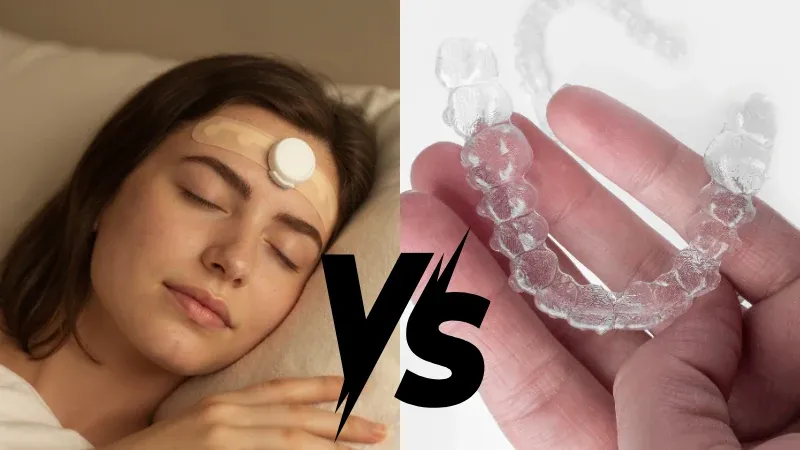
Night guards are the most commonly recommended intervention for bruxism—but they protect teeth, not reduce grinding. Biofeedback, by contrast, aims to reduce the grinding behaviour itself. The research supports it. The problem? Biofeedback devices essentially don't exist on the consumer market.
Understanding what each approach actually does—and doesn't do—is essential for choosing the right management strategy.
How night guards work
Occlusal splints (night guards) create a physical barrier between upper and lower teeth. When grinding occurs, the splint absorbs and redistributes the force, preventing direct tooth-on-tooth contact.
What they do well:
- Protect enamel from further wear
- Prevent cracks, chips, and fractures
- Distribute clenching forces across a wider surface
- May reduce some muscle strain by changing jaw position
What they don't do:
Night guards do not stop grinding or clenching. The muscle activity continues—it's just occurring against plastic rather than enamel.
Here's the frustrating reality many people discover: some research suggests that certain splint designs may actually increase clenching in some individuals. The TMJ Association notes that while splints can protect teeth, "they don't stop the bruxism itself" and that a guard alone "does not always resolve jaw pain."
For most people who grind heavily, night guards are valuable for preventing dental damage. But they're a management tool — they don't change the underlying behaviour.
How biofeedback works
Biofeedback for jaw muscle activity works by sensing what the muscle is doing and answering it, while it's happening, with something you can perceive — a sound, a buzz, a light. The idea is to interrupt the habit at the moment it runs.
Here's the critical context: for most of the last forty years there was nothing you could actually buy. Products either never launched or briefly existed and then disappeared — GrindCare being the best-known case. That's why biofeedback is rarely recommended in practice: not because it doesn't work, but because for a long time there was nothing accessible to recommend. That is beginning to change, ours included, though "available" still means a short list of countries rather than a shelf in every pharmacy.
The mechanism differs for awake versus sleep bruxism:
For awake bruxism: Biofeedback builds conscious awareness. When clenching is detected, feedback prompts voluntary relaxation. Over time, this can retrain automatic habits.
For sleep bruxism: Research shows the brain can process sensory information during light sleep without full awakening. A systematic review of this approach found that a gentle cue delivered during light sleep can prompt the jaw to soften, and that it did so without measurably disturbing sleep (Jokubauskas & Baltrušaitytė, 2018).
What the research shows
Night guards
Decades of clinical experience support splints for dental protection. They're safe, well-tolerated, and prevent the worst physical consequences of grinding.
However, evidence that splints reduce grinding frequency or intensity is mixed. They address consequences rather than causes.
A night guard changes what the grinding lands on, not how often it happens.
Biofeedback
Small trials have looked at whether a cue delivered during sleep changes jaw muscle activity while it's running, and they point the same way: activity falls while the cue is being delivered (Jadidi et al., 2013). They are also short, they involve very few people — eleven, in that one — and they differ in what counts as an episode, so the size of the effect varies a lot between them. We describe the direction of that work rather than borrowing its numbers, because those numbers belong to the devices that were tested.
A systematic review and meta-analysis of biofeedback for sleep bruxism found that episode frequency fell significantly against placebo devices after five nights of use, and that the feedback did not disturb sleep architecture — while rating the quality of that evidence low to moderate, on small samples and methods too different to pool confidently (Jokubauskas & Baltrušaitytė, 2018). A later systematic review of sleep bruxism management reached the same shape of answer for biofeedback and called for larger, longer, randomised trials before efficacy can be settled (Minakuchi et al., 2022).
So the honest one-line answer to does biofeedback work for teeth grinding: published trials show jaw muscle activity falls while the cue is running, and whether it stays down afterwards is far less well studied, because almost no trial has followed anyone long enough to find out.
Key limitations, and they matter more than the finding: these are small studies, most run for nights rather than months, and they disagree about what counts as an episode — which is why the size of the effect varies so much between them.
On what happens after the device comes off, the picture is genuinely mixed rather than blank. A three-month randomised trial of a biofeedback splint found that once treatment stopped, bruxing bursts stayed significantly shorter, though they did not become less frequent (Bergmann et al., 2020). Other studies show a return to baseline. The honest reading is that something carries over in some measures for some people, and that nobody has followed anyone long enough to say whether it lasts — these are trials of nights and weeks, and the question needs years. That is a gap in study length, not evidence that the effect vanishes.
Those numbers belong to the devices that were tested, not to ours. We are recording our own and will publish them with the same hedges attached.
Night guard alternatives compared
Three of the common options aim at different parts of the same problem. Read across the row you care about.
| Night guard | Botulinum toxin | Biofeedback | |
|---|---|---|---|
| What it targets | The teeth | The muscle | The behaviour |
| Force or frequency? | Neither — it redistributes force across the guard | Force: a weakened muscle contracts less hard | Frequency: the cue interrupts episodes as they happen |
| Does the jaw still clench? | Yes, against plastic instead of teeth | Yes, with less force behind it | That is the thing being measured |
| Evidence | Decades of clinical use for dental protection; mixed for reducing activity | Reduces clenching force; effect wears off over months | Small short trials show activity falls while the cue runs; long-term effect unresolved |
| What it costs | €400–800 custom, replaced every one to three years | €400–700 a session, repeating indefinitely | Almost nothing on the consumer market to buy |
| Reversible? | Yes | Wears off in months | Yes — you can stop wearing it |
A night guard protects teeth from the consequences of grinding; botulinum toxin lowers the force behind it; biofeedback is the only one of the three aimed at how often the jaw does it at all.
Biofeedback devices themselves differ in what they read — tooth contact during the day, or the jaw muscle itself, day and night. Clench Alert vs JawSense takes that one apart.
Cost and accessibility
Night guards:
- A custom dental guard: €400–800, replaced every one to three years
- Over the counter: €15–50
- One-time purchase (though custom guards may need replacement every few years)
- Widely accessible through any dentist
Biofeedback devices:
- Essentially no consumer options currently available
- Research devices used in clinical trials are not commercially sold
- Historical products (like GrindCare) showed results but were discontinued
- This gap between validated research and available products is a significant problem in bruxism care
You can buy a night guard from any dentist this week; there is almost nothing to buy on the biofeedback side, which is the real reason most people have never tried it.
Can you use both?
Night guards and biofeedback are not mutually exclusive. In fact, a combined approach may be most practical:
- Night guard: Provides immediate protection while working on behaviour change
- Biofeedback: Targets long-term reduction of grinding activity
This mirrors how bruxism experts increasingly think about management: multimodal approaches addressing both consequences (dental protection) and underlying behaviour (awareness and modification).
The bottom line
Night guards manage consequences. Biofeedback targets causes.
Choose night guards if:
- Primary concern is protecting teeth from further damage
- Looking for a simple, well-established intervention
- Symptoms are primarily dental rather than pain-related
Consider biofeedback if:
- Want to reduce the grinding behaviour itself
- Have already tried splints without adequate relief
- Interested in awareness training for awake bruxism
Consider both if:
- Have moderate to severe bruxism with ongoing dental damage
- Want protection while working on longer-term behaviour change
Neither approach is a "cure." Bruxism is a complex behaviour influenced by stress, sleep, and neurological factors. Effective management typically requires multiple strategies working together—dental protection, awareness training, stress management, and physical therapy.
The future probably lies in combining the two: something that protects the teeth, and something that works on how much the jaw is doing. Until then, understanding what each tool actually does helps set realistic expectations and choose wisely.